A curious television segment aired 8 September 2012 on TeleBielingue combines historical narration with a playful visual gag. While presenter Claudia Nuara describes the alleged “goat’s tongue” torture, a man removes one of her shoes and tickles the sole of her foot with a feather. Nuara attempts to maintain her composure, continuing her serious explanation while visibly trying not to laugh.
Leggi tutto: Tickling scenes in “TeleBielingue”Nuara addresses the audience formally before describing a supposed torture method associated with medieval interrogation and the Inquisition.
The historical practice is generally known in English as “goat’s tongue.” A 2001 article published in the British Medical Journal describes an alleged method in which a victim’s legs were restrained and the soles of the feet were moistened with salt water. A thirsty goat was then made to lick the feet, supposedly until the skin was worn away.
The presenter describes the method as a terrifying instrument of interrogation, while the unseen or partially visible comic action turns the same idea into a television performance. The feather applied to her foot does not reproduce the historical claim about salt water and a goat, but it creates an immediate visual parallel: the solemn account is accompanied by a harmless form of tickling that challenges Nuara’s ability to remain serious.
The gag depends on the audience recognising that the presenter is simultaneously acting as a historian and becoming the subject of the demonstration.


During the segment, a man removes the host’s shoe and begins by running the feather under her foot. The host initially appears unfazed and continues to discuss the topic, though she can be seen smiling from time to time (although this might be due to the bizarre subject matter). The man begins to poke her with the tip of the feather on the surface of her foot and relentlessly continues to run the feather back and forth along the sole. The presenter can be heard gradually stuttering, floundering, smiling broadly, and giggling, while the camera repeatedly shows her foot wriggling and trying to escape the torment.
She continues explaining the alleged procedure while trying not to laugh, creating a deliberately uncomfortable gap between the grave tone of the narration and the light, theatrical treatment of the scene.
History of the goat’s torment from Telebielingue
The following is an English translation of the intervention:
“Ladies and gentlemen, thank you for joining us on this 8 September 2012 for a very special edition. We have just learned, not without some emotion, that a certain thirty-year-old man had to get down on his knees to carry out the famous goat’s torture.
During the Middle Ages, around the year 1370, the Catholic Church established a specialised tribunal known as the Inquisition. Its task was to judge those accused of opposing the authority of the pope—in other words, the authority of Rome. These people, known as heretics, were first judged before a tribunal of ecclesiastics and were then subjected to torture in order to make them confess their faults and obtain redemption. One particular feature of the Inquisition was that adulterous women, like witches, were also handed over to torture.
Several wives suspected of betraying their husbands supposedly confessed under what may have been one of the least atrocious tortures in terms of lasting injuries, but certainly one of the most effective in making people talk: the terrible goat’s torture.
The procedure was as follows. The condemned woman was first taken to a dungeon, generally located in the basement of one of the fortified castles of the period. There, a heavy and mysterious atmosphere prevailed, enough to make even the bravest among us shudder. The accused woman was placed on a wooden seat fixed against a pillory, and her hands were tied to the post. At the front of the wooden seat there was a wooden stock, a rectangular device through which the feet and ankles could pass. The victim’s ankles were placed inside it, and it was then firmly closed with metal fastenings.
At that point, the executioner entered the scene to begin his work. He started by removing the condemned woman’s chains, shoes and stockings. He then went to a corner of the room where the instruments of torture were kept and prepared a mixture of salt and water in a bucket. Once the brine was ready, he returned to the soles of the unfortunate woman’s feet and energetically applied the mixture. The anxiety and nervousness visible on the condemned woman’s face then gave way to slight—she could no longer restrain a few moans as the brush moved mischievously across the soles of her feet.
Once the mixture had been applied, the executioner went to an adjoining room and returned with a hungry goat that had previously been deprived of food for an entire day, so that the torture and its effects would be as effective as possible. The goat was held on a leash and placed directly beside the condemned woman’s feet.
From the first strokes of the animal’s tongue, the victim could no longer contain herself and began laughing loudly. This scene naturally amused the people present at the event: the king, the priest responsible for the interrogation and the queen’s servants. After ten minutes, the victim would generally confess her sins and promise not to repeat her misdeeds, under threat of suffering the same torture again.
Today, this kind of torture still delights certain historical enthusiasts, as well as some television game shows, such as Le Jeu de l’oie, seen on a Spanish channel,

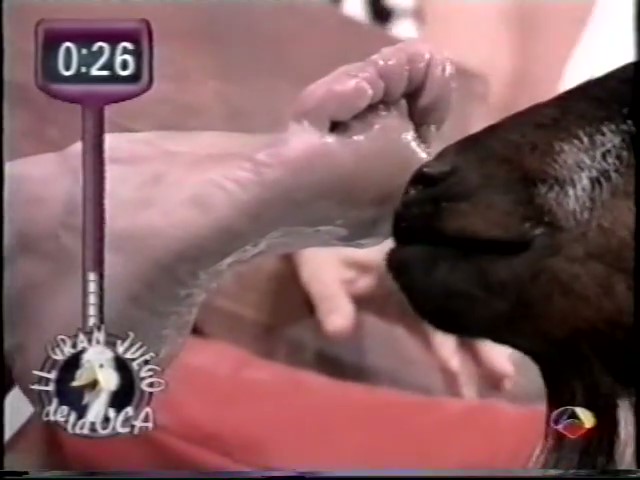
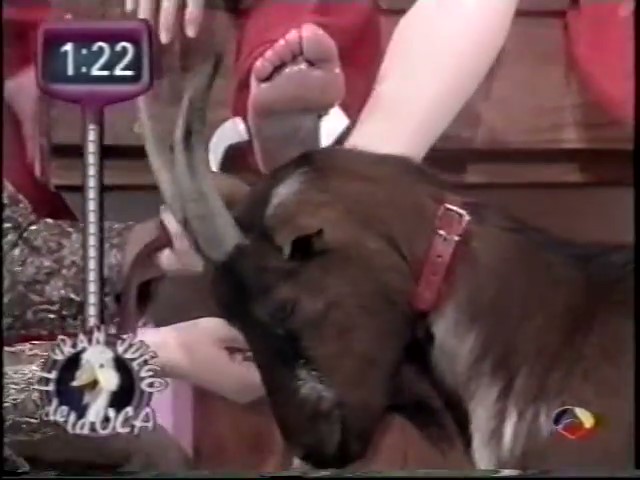
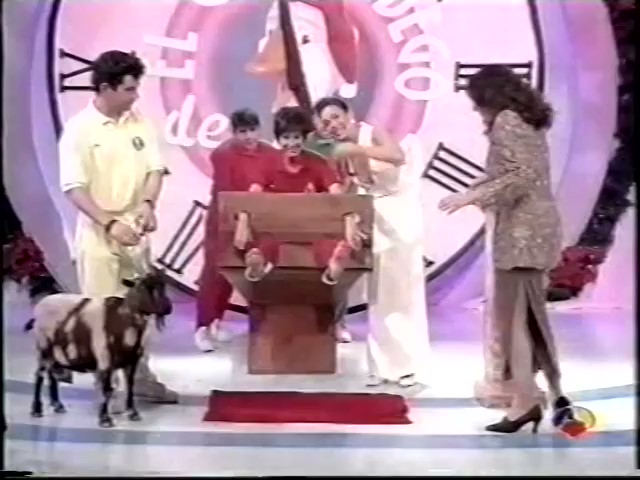
or, more recently, the Joutes d’Interville broadcast on France Télévisions.”


The intervention presents the “goat’s tongue” as a routine instrument of the medieval Inquisition and places it around 1370. That framing is more definite than the surviving evidence allows. The best-known modern medical-historical description confirms the basic image of salt water, restraint and a goat licking the feet, but it does not establish that the practice was a standard or widely documented procedure of the Inquisition.
Consequently, the TeleBielingue passage is most accurately understood as a humorous television reconstruction built around a striking historical legend. Its comedy comes from the deliberate collision between a solemn account of torture and the presenter’s struggle to suppress laughter as her bare foot is tickled.
Informazioni sull'autore

Related posts:
 Tickling Scenes in “Club Dorothée” and “Pas de pitié pour les croissants”
 Tickling scenes in “El gran juego de l’oca” and variants
 List of Tickle Scenes in “Fist of Zen” and “Silent Library”
 Best tickle torture in stocks scenes
 List of Babinki tickling and ticklish reflex scenes
 History of goat’s tongue and list of goat tickle torture scenes
 Goat tickle scenes in “Tiere Wie Wir”
 Tickling scenes in Paul Panzers Comedy Spieleabend
 Tribute to De Kiekeboes | Most Iconic Fanny Kiekeboe’s sensual and tickling scenes
 Tickling scenes in “El gran Juego de la Oca”
 Tickling scenes featuring sushi models
 List of tickling scenes in “The Howard Stern Show”