Tickling is usually presented in popular culture as a playful prank, a form of affection, a source of embarrassment, or, in darker stories, a method of coercion. There is another recurring use that is particularly interesting because it turns ticklishness into a practical obstacle: tickling someone specifically to interfere with what they are doing.
Last update: 09/24/2026
Leggi tutto: Best ticklish distraction scenesThe basic idea is simple. A character is trying to concentrate, keep still, maintain a physical position, answer a question, perform a precise movement, hold onto something, or simply behave normally. Someone else starts tickling them, and the resulting laughter, reflexive movements, squirming, flinching, and loss of concentration make the original task much harder. The tickling is therefore not necessarily the objective of the scene. It is the distraction.
This device appears in cartoons, comics, television comedy, game shows, films, anime and occasionally behind-the-scenes accounts of productions. It works particularly well on screen because the audience can immediately understand the conflict: the character is attempting to remain composed while their body keeps reacting against their intentions.
The “stay focused” ticklish distractions
The clearest mainstream example is probably the British television game show Distraction, presented by Jimmy Carr. The programme was broadcast on Channel 4 from 2003 to 2004 and was built around the idea of forcing contestants to answer relatively simple questions while being subjected to increasingly bizarre distractions.
Here tickling is not merely a comic interruption within a larger story. It is the entire premise of the competition.
Contestants have to retrieve information and answer questions while their attention is being deliberately compromised. Among the show’s various distractions was a particularly memorable setup in which contestants were suspended or positioned upside down while their bare feet were tickled. The same basic device appeared in the UK, Italian and Indian versions of the format.
This makes Distraction an unusually pure example of ticklish distraction in mainstream entertainment. The tickling is an obstacle placed between the contestant and a cognitive task. They know the answer, but the programme wants to find out whether they can still access it while their attention and physical composure are being disrupted.


The Italian edition provides several variations on the same principle, including contestants being tickled on their feet while attempting to participate in the challenge.


The format also demonstrates why tickling is particularly effective as a television distraction. A loud noise or complicated visual effect can interfere with concentration, but tickling produces a visible physical reaction. The audience can see the contestant trying to suppress laughter, shifting position, twisting away or losing their train of thought.
In “Family” a woman is distracted by her boyfriend while trying to study.


In “Interville,” a woman must answer questions that are theoretically simple while being distracted by feathers tickling her feet.


“Keerang Radio” features a challenge in which a woman is subjected to intense tickling while she tries in vain to stay focused and answer questions.


In an episode of The Howard Stern Show, Crystal Klein is distracted from playing the piano properly while Howard Stern tickles her naked body.


In a BBC Radio episode, Jessie J is distracted by tickling and some contortionists.


In “The Blonde,” two evil women use tickling to distract the two prisoners and prevent them from using telepathy. The plan succeeds.


The “don’t move” ticklish distractions
Tickling is used on a person to test the stability of their stance and force them to move.
On some television shows, yoga practitioners are tickled on the soles of their feet or on their hips to get them to move, usually for comedic effect.
A character might be standing on one leg, walking along a narrow surface, holding a difficult pose, climbing, reaching for something or attempting a feat of physical coordination. Tickling then becomes a tiny intervention with disproportionately large consequences.
The important point is that the tickling does not have to overpower the character. It only has to introduce enough involuntary movement to compromise an already delicate action.
The result resembles a slapstick version of sabotage: the attacker does not destroy the task, but makes it impossible for the other person to perform it properly.
In “Poland Got Talent”, a sushi model is distracted by her immobility when some men tickle her bare feet.


In “Drunken Master,” the protagonist is tickled by an opponent in an attempt to break his concentration.
From: “Me Caligo de Risas”
The “losing the grip” ticklish distractions
A character has captured someone, is holding onto an object, is balancing somewhere precariously, or is attempting to carry out an important action. The other character discovers that a tickle is enough to make them lose their grip.
The classic cartoon logic is especially well suited to this because animated characters can react with exaggerated jumps, spasms and contortions. The stimulus can be tiny while the response is enormous.
This is also why tickling works as a nonviolent equivalent of a conventional cartoon attack. Instead of punching someone, knocking them unconscious or physically overpowering them, a character can simply make them laugh and wriggle until they lose control of whatever they are doing.
An examples of losing the grip from Ace Ventura:
The same mechanism appears throughout slapstick animation. Feet, ribs and underarms are particularly useful because they are immediately recognizable as ticklish areas, while the resulting movement can be exaggerated without requiring an elaborate explanation.
In “Tatsu no Taro,” an ogre is repeatedly tickled in order to make him lose his grip and fall into the void.


In “One Piece,” Chopper is tickled to make him lose his balance and drop things.


In “Sherlock Hound” (Ep. 9), Inspector Lestrade is tickled under the arms by the robotic limbs of a submarine to distract him from his attempt to block the view and make him let go.


In “Dark Star”, a man is tickled under his armpits by an alien to make him fall.
The “keep your face straight” ticklish distractions
A subtler form of ticklish distraction involves suppressing a visible reaction.
The character is expected to remain serious while being tickled. They might be participating in a ceremony, posing for a photograph, answering questions, performing on stage or simply trying not to laugh in front of other people.
The comedy comes from the gradual breakdown of self-control. At first the character insists that they are unaffected. Then they start smiling. Their body shifts. They try to suppress the reaction. Eventually they laugh or lose the pose altogether.
This pattern is particularly common in television comedy because it requires very little exposition. The audience understands immediately why someone who is supposed to remain expressionless has a problem when another character starts tickling them.
In “Glory,” a man tries to keep a straight face on the phone while a woman tickles his feet.


Comedic ticklish distractions
In the context of a television show or a reenactment of a situation, a person may be tickled in order to break their concentration, making it difficult or impossible for them to perform, with the aim of creating a humorous situation.
In “Colorado,” Federica Nargi is tickled twice—under her armpits and on her hips—by her co-host, who makes it impossible for her to host the show, creating a comical interlude due to this unintentional distraction.
In an iconic television scene aired on “Giga TV,” Miriam Pielhau is tickled on the soles of her feet during the broadcast. Noticing the hands approaching, she tries to keep her composure and continue with the announcement, but within a few seconds she starts laughing and is forced to shoo away the playful prankster.


In General Hospital, a character’s feet are tickled while she is standing before other people, producing laughter and interfering with her composure.


In Love, Chunibyo & Other Delusions, Episode 4, a girl is tickled under the foot by a younger girl while she desperately tries to give a speech in front of the class.

In a Le Morgane’s parody of Adam’s “Go To Go,” three girls are prompted to perform a song while being tickled under the armpits, on the hips, and on the soles of their feet, respectively.
At first, the three women sing normally, but then they start smiling more and more conspicuously, and as the camera shows the hands tickling them, they have increasing difficulty performing the song, mixing up the words or bursting into laughter and being unable to continue.


In Mermaid Melody, Episode 25, a mermaid is tickled by her friends to distract her from the hypnosis that is causing her to reveal that she is a mermaid.


The “incapacitated by tickling” ticklish distractions
One or more characters are tickled—in a comedic context, though not necessarily—to the point that they are unable to act normally, move freely, or fight back.
In Pokemon videogames, tickling is a move that can weak the enemy’s defense.
Murfy can tickle and distract enemies in Rayman Legend.
In “The Purge,” Mary Sandin is held down by her attackers, including a woman (“Blonde Tickling Purger”) who tickles her stomach to distract her amid the atmosphere of terror.


In “Zenon the Zequel,” two girls are struck by an energy that, as a means of defending the territory, causes them to feel an intense tickling sensation, leaving them unable to react because they are laughing and writhing in laughter.


In “Superstretch and Microwoman,” Episode 9, Microwoman tickles an opponent on the hips, rendering her unable to react because she’s laughing so hard.


In the Harry Potter franchise, rictusempra is a tickling spell which leaves the victims unable to react because they are laughing from being tickled.
In “One Piece,” Nico Robin uses her hands to tickle Luffy, distract him, and keep him from getting into trouble.


In “The Sex Files: Sexually Bewitched,” a witch is tickled by her teacher while making love to her lover under the influence of voodoo magic: because of the tickling, she is forced to laugh without being able to explain why.


In “Dragon Ball Z,” Goku is pinned down and tickled all over his body by Caterpy with her little hands, which prevents him from concentrating and trying to break free, despite the obvious difference in strength.


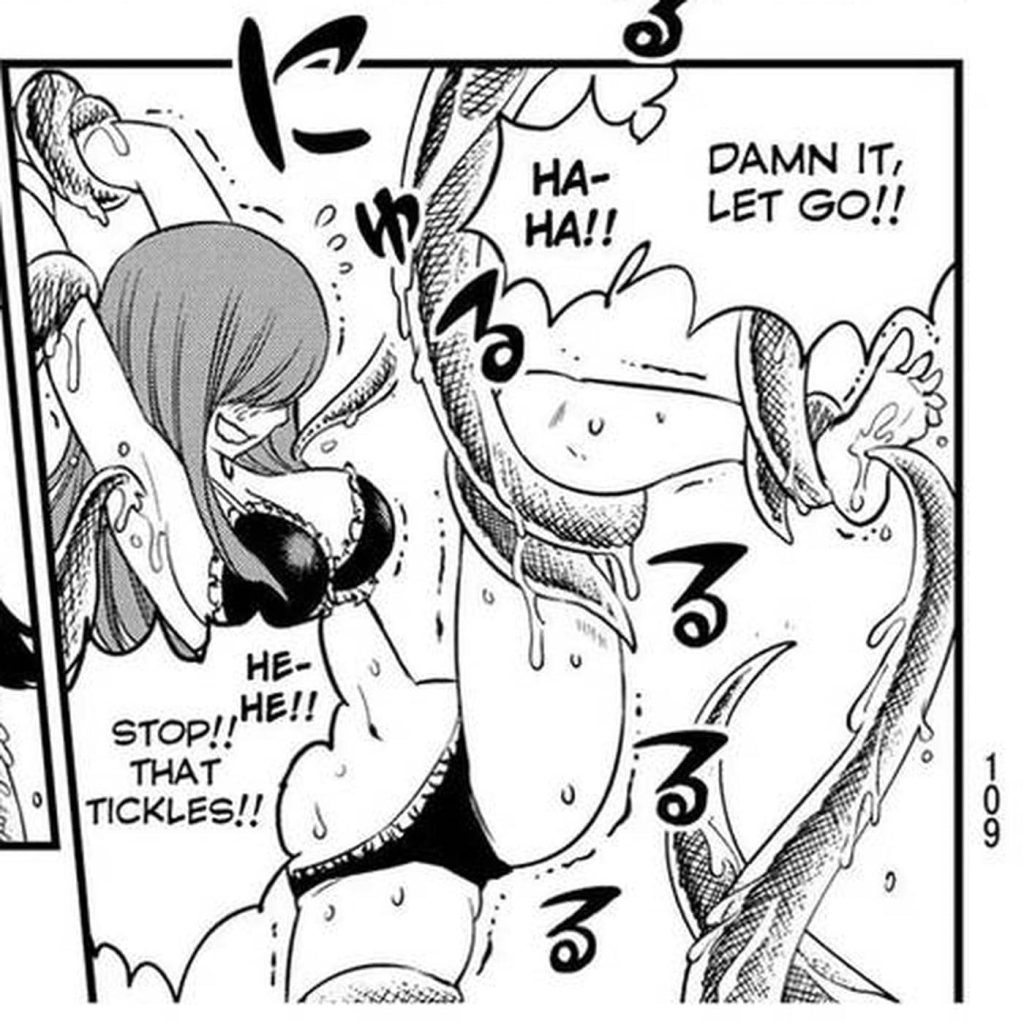
Erza Scarlet is incapacitated by tickling in Fairy Tail: Hero.
Informazioni sull'autore

Related posts:
 List of tickling scenes in “The Howard Stern Show”
 Tickling scenes with adult models
 List of tickling scenes in Italian TV shows
 Vote For The Greatest Ticklish Character of All Time!
 Top tickling scenes in videogames
 Tribute to Lucy Heartfilia | Most iconic sexy and tickling scenes
 Most iconic tickling machines and tickle torture devices
 Tickling scenes in Dr. Slump” and “Dragon Ball”
 Tribute to Fujiko Mine | Most iconic sexy and tickling scenes
 List of ticklish superheroes
 Tickling scenes featuring sushi models
 Top 10 Tickler Heroes